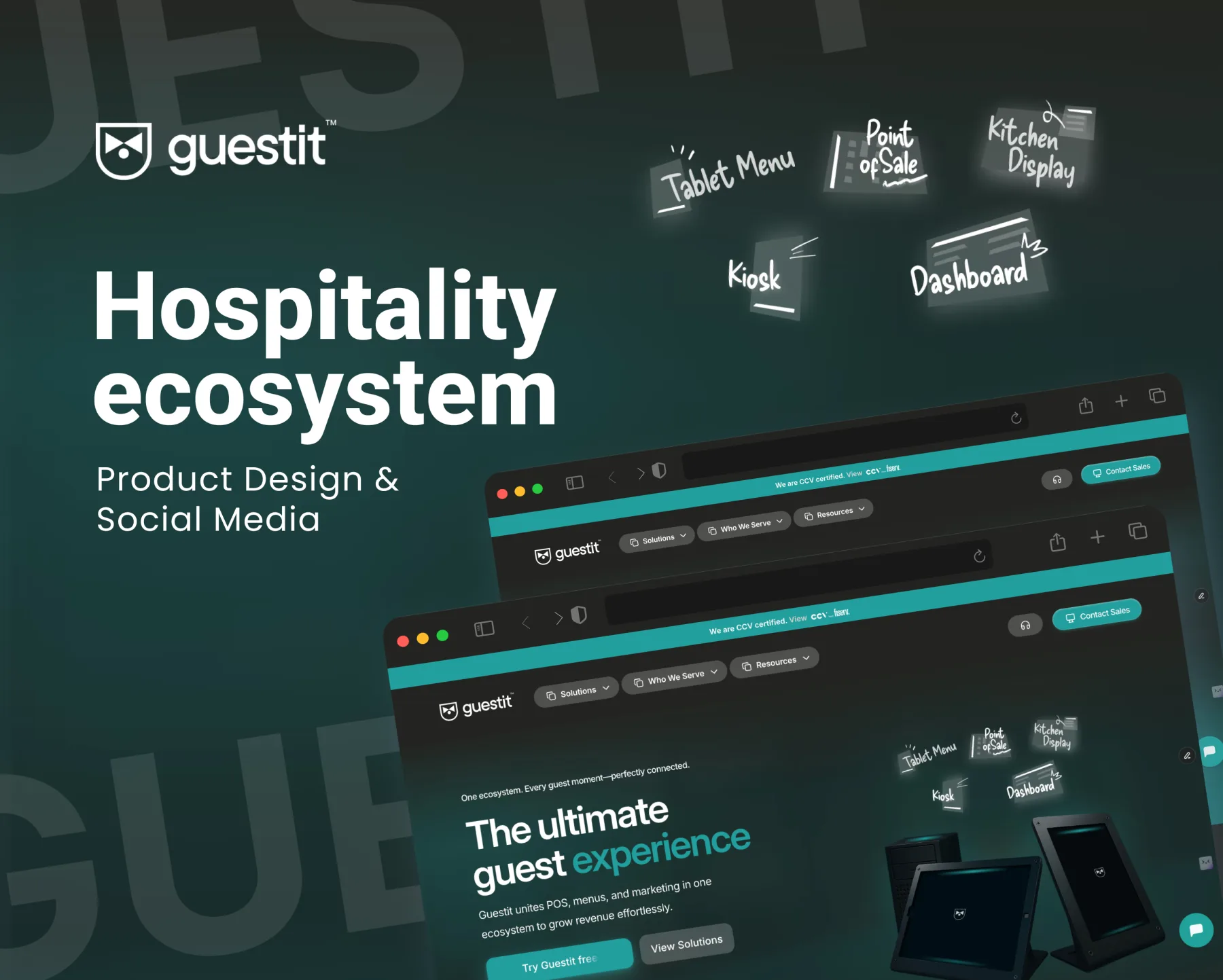
Hospitality teams often operate POS, tablet menus, kiosks, kitchen displays, dashboards and marketing as separate tools. Guestit needed to communicate how those surfaces work as one ecosystem rather than a catalogue of disconnected products.
06 / Hospitality technology
Guestit Hospitality Ecosystem
One connected hospitality ecosystem bringing POS, menus, kitchen displays, kiosks, dashboards and marketing into a coherent product experience.
 Selected work · 06
IndustryHospitality operations
Visual Side roleProduct strategy, ecosystem UX and digital brand direction
Delivery modelFounder-led project
Project screens / 03
A closer look at the work.
Explore the interface, content and system decisions in context. Select any screen to open the complete gallery.
From the real
challenge to a usable system.
The product story was structured around a shared hospitality model connecting locations, menus, orders, devices, staff workflows, guest touchpoints and operational reporting.
The resulting direction presents Guestit as a connected hospitality operating ecosystem rather than a collection of unrelated tools.
What needed to change
Problem
Hospitality teams often operate POS, tablet menus, kiosks, kitchen displays, dashboards and marketing as separate tools. Guestit needed to communicate how those surfaces work as one ecosystem rather than a catalogue of disconnected products.
The experience had to serve operators evaluating the platform while making the operational relationship between devices, guest actions and business outcomes understandable. The challenge was to explain a technically broad system without losing speed, focus or brand character.
- Present six operational surfaces as one ecosystem
- Make platform value clear to hospitality operators
- Balance technical breadth with a focused sales journey
How we shaped the experience
UX process
The UX process mapped the operator journey from understanding the ecosystem to evaluating individual solutions and requesting a sales conversation.
Product relationships, proof, navigation and calls to action were organized around progressive evaluation. Responsive prototypes tested how a complex B2B offer could stay understandable across desktop and mobile without hiding key product depth.
- Hospitality operator decision journey
- Solution comparison and ecosystem navigation
- Responsive evaluation and contact pathways
How the system connects
Architecture
The product story was structured around a shared hospitality model connecting locations, menus, orders, devices, staff workflows, guest touchpoints and operational reporting.
A reusable solution architecture allowed each product to stand on its own while showing how data and actions move through the complete ecosystem. Shared content patterns created room for future solutions, resources and integrations.
01Connected menu, order and device model02Reusable structure for every Guestit solution03Clear platform, resource and integration relationships
How consistency was built
Design system
A dark, technology-led visual system gave Guestit a recognizable product presence while keeping a large platform offer easy to scan.
Solution modules, browser presentations, device imagery, navigation, proof and conversion patterns were built as one responsive language. Teal accents connected digital and physical product touchpoints without overwhelming the information hierarchy.
01Distinct hospitality technology identity02Reusable solution and device presentation modules03Consistent responsive hierarchy and interaction rules
How the work became build-ready
Development
The work was prepared as a practical responsive system with repeatable content blocks, interaction behavior and implementation guidance.
Image performance, content management, form behavior and integration points were considered alongside the interface. This kept the visual experience achievable without creating a fragile or difficult-to-operate website.
- Responsive implementation specifications
- CMS-ready content and media patterns
- Performance and integration guidance
What the project unlocked
Outcome
The resulting direction presents Guestit as a connected hospitality operating ecosystem rather than a collection of unrelated tools.
Operators receive a clearer route from platform understanding to solution evaluation, while the business gains a reusable digital foundation for new products, proof and market-facing content.
- Clearer understanding of the complete ecosystem
- Consistent product story across responsive surfaces
- Reusable foundation for new solutions and content
Client perspective
“Client feedback remains confidential for this engagement.”Confidential hospitality engagement