Legal and business guidance becomes difficult to use when it is stored as long documents, disconnected templates and expert knowledge that depends on the right person being available.
09 / Knowledge platform
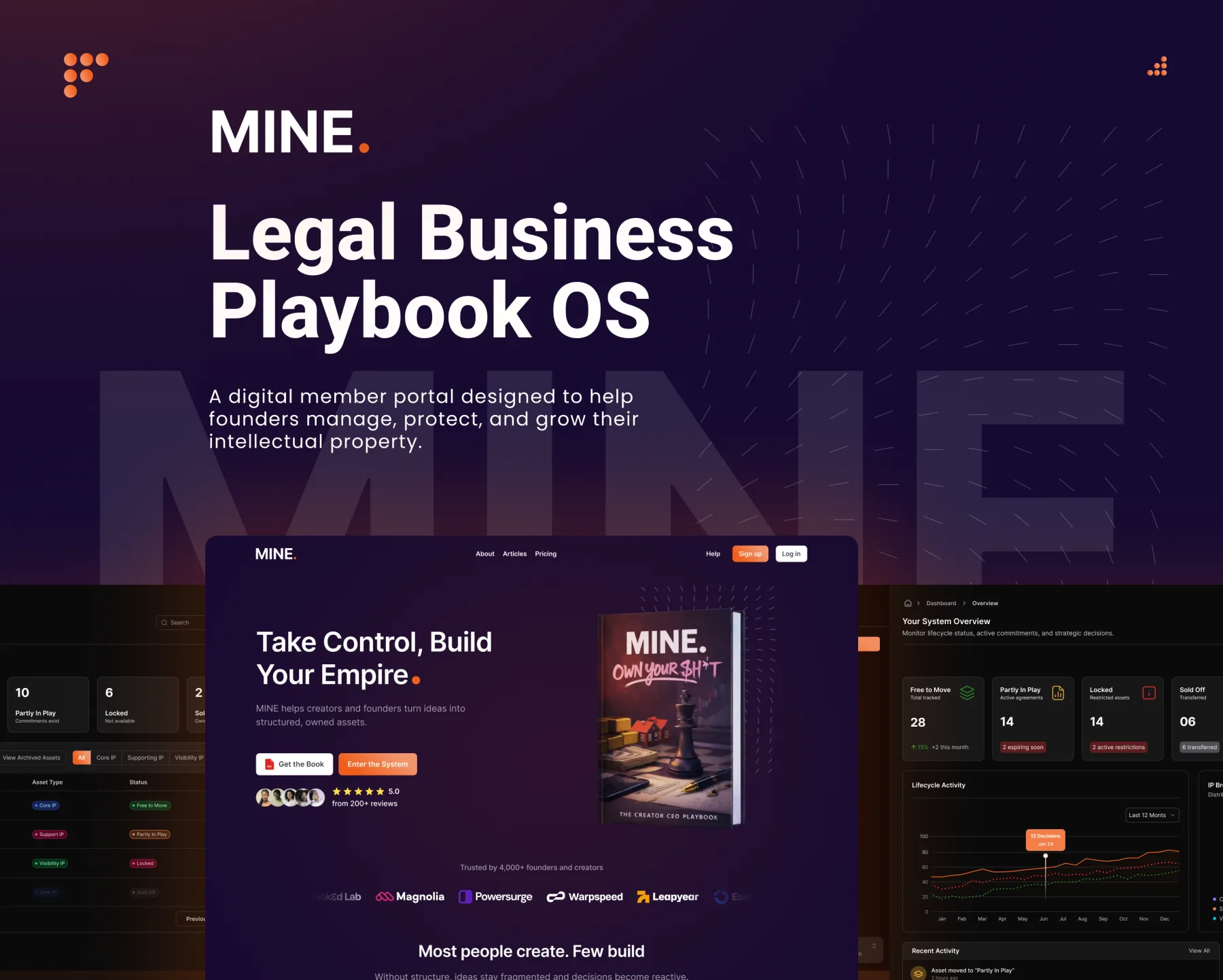
Legal Business Playbook OS
A structured legal business operating system turning complex guidance, playbooks and workflows into a usable digital product.
 Selected work · 09
IndustryLegal services & business operations
Visual Side roleProduct architecture, knowledge UX and operating-system design
Delivery modelFounder-led project
Project screens / 03
A closer look at the work.
Explore the interface, content and system decisions in context. Select any screen to open the complete gallery.
From the real
challenge to a usable system.
The platform model separated topics, playbooks, steps, decisions, templates and supporting resources while preserving their relationships.
The resulting direction transforms a body of specialist knowledge into a clearer, repeatable digital operating system.
What needed to change
Problem
Legal and business guidance becomes difficult to use when it is stored as long documents, disconnected templates and expert knowledge that depends on the right person being available.
The project needed to turn a large body of structured expertise into an operating system people could navigate, understand and apply. Content depth, user confidence, permissions and maintainability all had to be addressed without presenting the platform as a substitute for context-specific professional advice.
- Turn dense expertise into actionable pathways
- Connect playbooks, resources and workflows
- Preserve clarity, boundaries and maintainability
How we shaped the experience
UX process
The UX process started with real user intentions: understanding a topic, diagnosing a situation, following a process, finding a template and knowing when additional support was required.
Information architecture and prototypes explored guided entry points, search, progressive disclosure, checklists and saved progress. The experience prioritized orientation and next steps so users could move through complex material without losing context.
- Intent and task-based journey mapping
- Guided playbook and resource prototypes
- Search, progress and decision-support patterns
How the system connects
Architecture
The platform model separated topics, playbooks, steps, decisions, templates and supporting resources while preserving their relationships.
Reusable content structures allowed knowledge to be updated once and presented in different relevant contexts. Access, versioning and ownership considerations were included so the system could operate as a managed product rather than a static library.
01Structured playbook and knowledge model02Connected steps, decisions and reusable resources03Access, versioning and content-ownership framework
How consistency was built
Design system
A precise, calm interface language reduced the visual weight of complex material and made progress, hierarchy and actions easier to understand.
Navigation, topic cards, playbook steps, callouts, checklists and resource patterns were designed as one component system. States for completion, attention, restricted access and supporting context created consistency beyond the primary reading view.
01Clear knowledge and workflow hierarchy02Reusable playbook, checklist and resource components03Consistent progress, access and attention states
How the work became build-ready
Development
The solution was documented as a content-driven application with reusable templates, role-aware behavior and manageable publishing workflows.
Specifications covered structured content, search behavior, progress states, permissions and future integration boundaries. This gave implementation teams a practical model for building and maintaining the system over time.
- CMS and structured-content requirements
- Role, progress and search-state specifications
- Implementation model for a maintainable knowledge product
What the project unlocked
Outcome
The resulting direction transforms a body of specialist knowledge into a clearer, repeatable digital operating system.
Users gain more direct paths to relevant guidance and actions, while the business gains a structured platform for maintaining, extending and delivering its intellectual property.
- More usable route through complex guidance
- Reusable system for playbooks and workflows
- Scalable foundation for managed knowledge delivery
Client perspective
“Client feedback remains confidential for this engagement.”Confidential legal technology engagement