The service journey crossed discovery, vessel information, customer requests and operational follow-through, but those moments did not yet feel like one premium experience.
05 / Service ecosystem
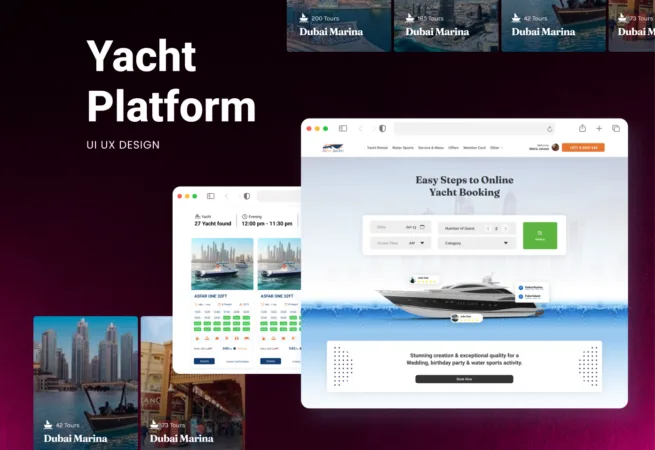
Yacht Platform
A premium digital ecosystem connecting customers, operations and service delivery across touchpoints.
 Selected work · 05
IndustryLuxury services
Visual Side roleProduct, UX and operational platform design
Delivery modelFounder-led project
Project screens / 03
A closer look at the work.
Explore the interface, content and system decisions in context. Select any screen to open the complete gallery.
From the real
challenge to a usable system.
The platform architecture connected vessels, services, destinations, availability, customer accounts, requests and operational updates.
The platform became a coherent premium service system rather than a set of disconnected pages and requests.
What needed to change
Problem
The service journey crossed discovery, vessel information, customer requests and operational follow-through, but those moments did not yet feel like one premium experience.
Different audiences arrived with different intentions: exploring vessels, planning an experience, requesting a service or managing an existing relationship. The platform needed to guide each person clearly while preserving a consistent high-value brand experience.
- Unify fragmented customer and service journeys
- Support multiple high-intent audience needs
- Balance premium presentation with operational clarity
How we shaped the experience
UX process
We mapped journeys for prospective customers, existing owners, guests and service teams. Each path moved from discovery and evaluation toward inquiry, request, update and follow-up with fewer handoffs.
Vessel browsing, detail views, service selection, saved information and request flows were prototyped around calm decision-making. High-value actions were given clear context and a visible next step rather than forced into a generic contact form.
- Audience and service-journey mapping
- Vessel discovery and detail experience
- Contextual inquiry, request and follow-up flows
How the system connects
Architecture
The platform architecture connected vessels, services, destinations, availability, customer accounts, requests and operational updates.
Modular relationships allowed public content and customer workflows to share one system without exposing internal complexity. The model also created a foundation for future booking, partner and service-management integrations.
01Connected vessel, service and destination model02Customer, inquiry and request relationships03Foundation for booking and operational integrations
How consistency was built
Design system
The visual language used editorial scale, restrained color and generous composition to create a premium atmosphere, while structured interface patterns kept service information usable.
Vessel cards, galleries, specifications, service modules, forms and account states were designed as one responsive library. The system protected image impact without sacrificing reading, comparison or action clarity.
01Premium editorial and interface language02Reusable vessel and service components03Responsive image, data and action patterns
How the work became build-ready
Development
The delivery scope defined responsive platform templates, CMS structures and interaction behavior for public, customer and operational surfaces.
Media performance, inquiry routing, account states and integration boundaries were documented early. This helped the platform retain a polished experience while remaining realistic to build and operate.
- Responsive public and portal templates
- CMS, account and workflow requirements
- Media performance and integration guidance
What the project unlocked
Outcome
The platform became a coherent premium service system rather than a set of disconnected pages and requests.
Customers gain a clearer route from interest to service, while delivery teams gain a more structured view of information and next actions across the relationship lifecycle.
- Consistent journey across customer touchpoints
- Clearer visibility from inquiry to delivery
- Scalable base for future services and integrations
Client perspective
“Flexible and proactive—the product improved beyond the initial scope.”SaaS founder